


My short (and somewhat controversial) answer is to wait as long as you possibly can to file for Social Security.
The longer answer is that each client’s financial and health situation is unique, so the Social Security filing strategy is an ongoing discussion for us with our clients in the 60-70 age range.
For most of our clients, they are typically filing between the ages of 67 – 70. Yet there are other clients for whom filing as early as age 62 has made sense.
Filing before Full Retirement Age (67) Permanently Reduces Your Benefit
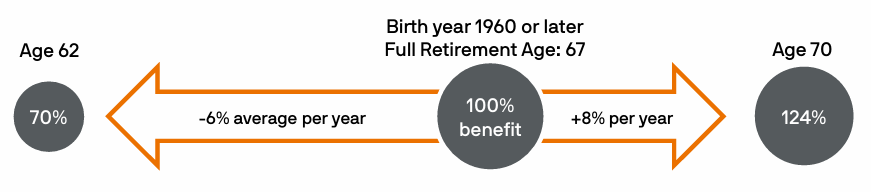
For each year ahead of age 67 that you file, it’s a 6% reduction in the benefit. For each year after 67 that you postpone receiving your benefit, it’s an automatic 8% raise.
I know what some of you are thinking: “I can earn more on my investments than those 6-8% Social Security increases.” I have heard this comment many times over the years. The logic is that by taking Social Security at age 62, you are able to withdraw less money out of your portfolio for living expenses. And if your portfolio grows at 8-10% per year, you are “ahead” by taking Social Security earlier.
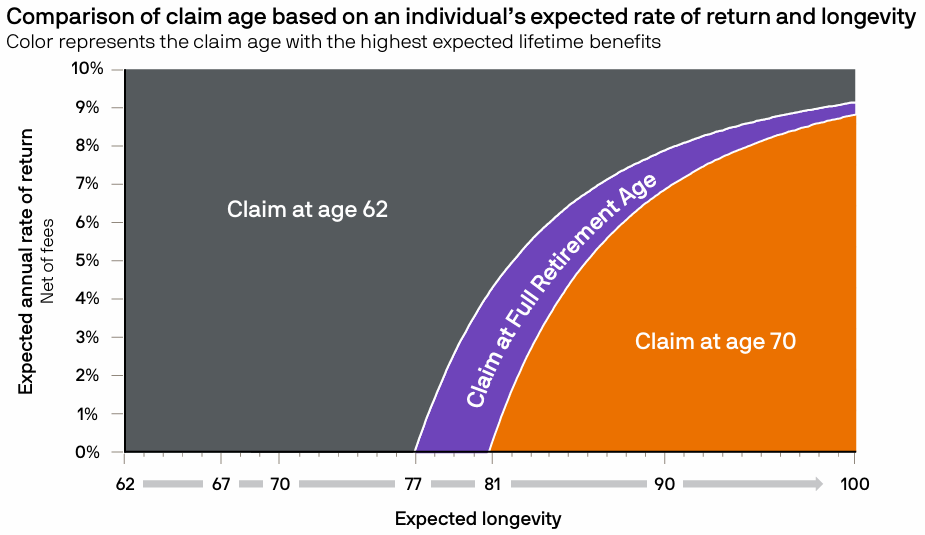
On a pure math basis, this is true. The chart below from JPMorgan illustrates this. If you can earn 10% on your investments, you are always better off claiming Social Security at age 62.
But as a wise man once said: a bird in hand is worth two in the bush.
I like to think of Social Security as longevity insurance. You might even call it an annuity or a bond, in that you have traded dollars (via taxation) for a lifetime income stream. Stock investments are at the opposite end of the risk spectrum: high potential return paired with higher risk (more price fluctuation).
Furthermore, most retired clients do not invest 100% of their investment portfolio in stock funds. They typically have 65-85% of their portfolio in stock funds, in order to reduce the volatility in their portfolio. Thus, their expected rate of return is lessened due to taking less risk. And so, a 9-10% “hurdle rate” in this scenario is harder to achieve.
Granted, the “guarantee” of this income by the US government is not as confidence-inspiring as it was in the past. More on that later in this article.
Delaying to Age 70 Can Significantly Boost Lifetime Benefits
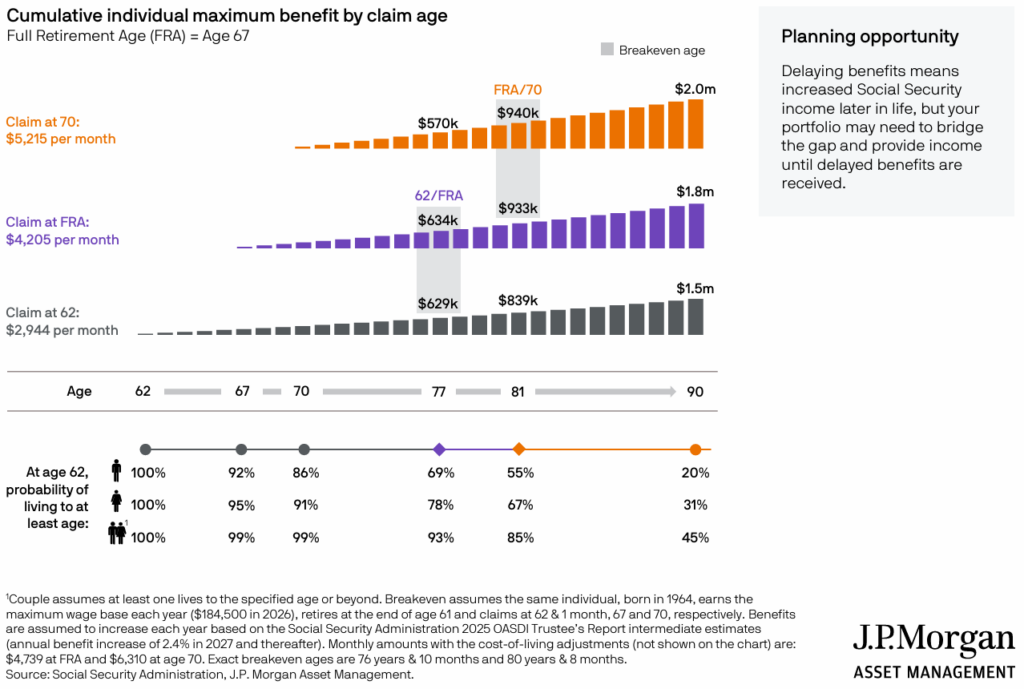
As the JPMorgan visual below illustrates, for people who live to age 90 or longer, lifetime benefits end up significantly larger for those filing at age 70 vs. earlier.
What About Quality of Life?
Some of our clients choose to file earlier than Full Retirement Age because they would rather have a larger income stream while they are younger and more mobile. We are sympathetic to this viewpoint.
Though the flip side of this argument is that having a larger Social Security benefit (through filing at 67 or later) helps provide added security later in life — such as the ability to afford the kind of healthcare and assisted living options of your own choosing.
Other clients have pointed to their family history as evidence they might not live to ripe old age. This is another reasonable argument for filing on the earlier side.
Social Security is Not Going Away
Our clients know how fiscally conservative we are: we abhor the ballooning national debt and unchecked spending of our tax dollars as much as anyone.
Our national debt is now over $40 trillion, with no immanent path toward fiscal responsibility visible.
The sad reality is that our debt will be paid for with increased US dollar printing, higher inflation (be it stealthy or outright), and higher taxation of productive Americans.
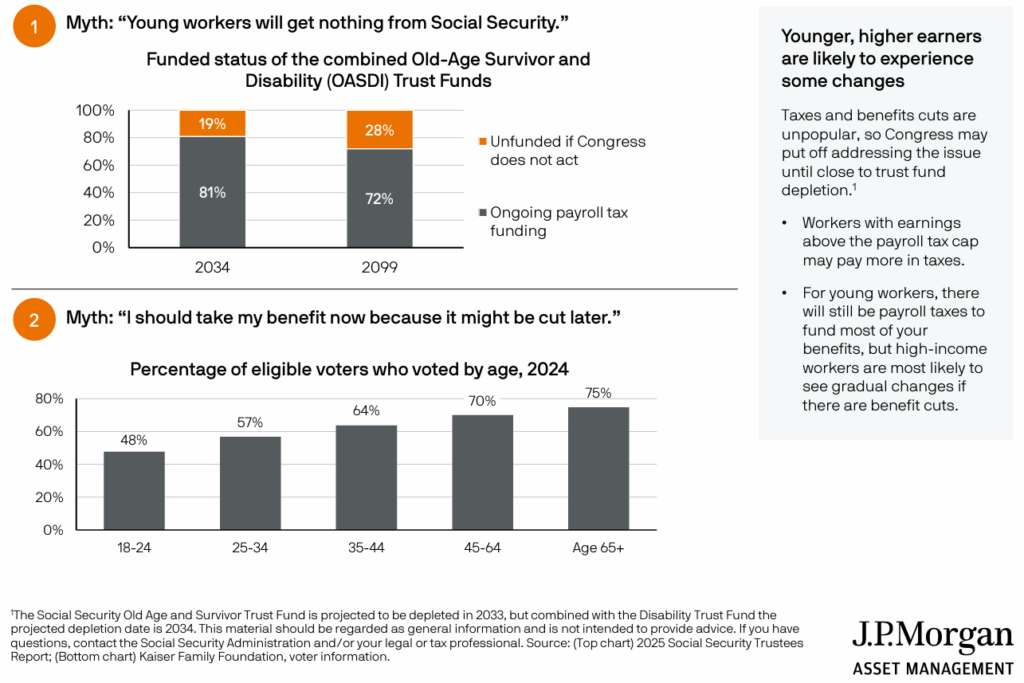
One of the simplest fixes to the Social Security solvency problem would be raising the Full Retirement Age for younger people. The last change to the full retirement age was 1983 (the year I was born). But the fastest way for a politician to get voted out of office is trying to reform Social Security. This is one of the challenges to a democracy. Reforming entitlements seems to be about the most politically impossible feat!
What does this mean to you, our client?
We are here for you! Social Security planning is an important part of the retirement planning process, and we will walk through it with you.